Who BSR consults
We speak to a wide range of people and organisations to deliver our projects, often including:
Statutory consultees
These include local planning authorities, parish and town councils, Natural England, Historic England, the Environment Agency, and utility and infrastructure providers. We engage with these bodies as part of the planning process, so their expertise and legal responsibilities help shape the final design. This engagement is formal, documented, and forms part of the planning record.
Non-statutory engagement
We go beyond planning rules. We inform and involve residents, landowners, MPs, ward councillors, and community groups near each site. They know their local area best, so we listen deeply to shape each proposal responsibly. This wider engagement isn't a planning obligation, but it is how we build an accurate picture of local concerns before we finalise a design. It sits alongside the council's own statutory consultation, rather than a replacement for it.
How the consultation process works, step by step
Step 1: Working with landowners and neighbours

We team up with the landowners to learn about the land, its history, and any constraints that might shape the design. We take the long-term view for our projects, so we build relationships with landowners that often run for decades, in some cases over 40 years. At the same time, we start notifying and engaging neighbours. The goal isn’t to show a final design, but to start a conversation while the proposal is taking shape. We offer site visits, talk through the proposals together, and listen closely to what neighbours have to say. Alongside this, we look at what’s on and around the site, and what the local community cares about, so it can all feed into the design.
Step 2: Pre-application community consultation
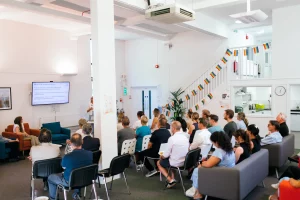
We hold a public consultation before submitting a planning application. This usually includes an exhibition event. Residents can drop in to see the proposed site layout, ask the project team questions, and submit written feedback. Alternatively, residents can respond by post or email.
We notify the community two to three months before the consultation event. Our outreach includes local MPs, ward councillors, and parish or town councils. We also use a website, local press, and a leaflet drop to properties in the notification area. Where possible, we include details in the relevant parish newsletter.
The notification area isn’t a fixed radius. We begin with a minimum distance of 1km from the site boundary, and we may extend it based on local context. This includes areas where construction traffic impacts roads further away or where the project is near a settlement. The aim is to reach everyone likely to be directly affected, while avoiding areas that would have no realistic impact. The consultation period is at least three weeks.
Step 3: Feedback collection and review
Every submission—whether it’s written, given at an event, or sent by mail—is collected, reviewed, and sorted by theme. These themes include visual impact, ecology, traffic, noise, land use, and more. We treat all feedback directly and equally, whether supportive or critical.

We record feedback in a Statement of Community Involvement (SCI). We do this for every BSR project and submit it with the planning application. It’s a public document, accessible via the local authority’s planning portal.
Step 4: Design revision
If feedback suggests changes to the design, we make them before submitting the planning application. For major changes, like moving a substation or removing battery storage, we must re-consult with the local planning authority and key consultees. We also inform affected parishes and neighbours directly. For minor changes, such as adjusting a fenceline or altering access tracks, we record them in the SCI.
Step 5: Planning application and ongoing availability
The formal planning process starts when we contact the local planning authority (LPA) for pre-application advice, even before we submit the application. Once it’s live, the LPA has its own consultation period. Residents can submit their views directly to the council, apart from any engagement with us.
We are here to answer questions from residents and parish councils during the planning process. Every BSR project has its own email address and contact details for the project’s duration. You can find your nearest project and its information here.
Step 6: Construction communication
Engagement doesn’t stop at planning. We keep our construction communications clear and ongoing. We talk directly with neighbours and send a quarterly newsletter during the building phase. This way, the local community stays updated on site activity, timelines, and programme changes. For sites that draw a lot of community interest during planning, we also host a construction information event, when neighbours can also meet members of our build team.
How to find out about a consultation near you
We show all active and upcoming projects on our open projects page. You’ll find contact details for each project there, along with information on current or planned consultations. You can also get in touch with us through our general enquiry form.
Each project in planning has a dedicated email address. You can use it to ask questions, request updates, or submit feedback anytime, even outside formal consultations.

What happens to your feedback
Our project team reviews every submission from consultation events. They also record these in the Statement of Community Involvement (SCI). This document goes with the planning application and is available on the local planning authority’s portal. It shows the feedback we received, how we categorised it, and how it influenced the final design.
A consultation can bring in a large amount of feedback, and we prioritise reading, categorising and acting on every submission over replying to each one individually. For all other changes, the SCI is the public record of how feedback shaped the application. You can check what happened to your feedback by viewing the SoCIE on the LPA’s planning portal. You can also contact the project team directly.
Where community feedback has shaped BSR projects
In our five-week pre-application consultation, community feedback raised two main concerns: how construction vehicles would affect local roads and the visual impact of the solar park on the landscape.
We made two design changes before submitting the planning application. First, we removed a construction compound to cut down on traffic. Then, we planted three extra rows of trees around the site to lessen the visual impact on nearby properties and viewpoints.
Braintree District Council granted planning consent in December 2024. We credit the application’s success to a thorough consultation process and the changes made in response to community feedback.
BSR gave a £50,000 grant to Belchamp Community House to fund energy efficiency upgrades, including insulation, new windows, and underfloor insulation in the main hall. With the work now complete, the Community House held an open day on 5 February. Trustee Clive Waite said the results have “gone extremely well” and that the building is now “lovely and warm.” A £50,000 Community Benefit Fund will be available through the Essex Community Foundation once Knowl Green Solar Park is energised.
Capacity
Planning consent granted
A few more examples of feedback shaping our projects:
- Elmley Road, Sheerness, UK – pulled panels back from a neighbouring house, following conversations with near neighbours.
- Harp Farm, Maidstone UK – changed the construction traffic route, following feedback raised at a parish council meeting.
- Tewes Farm, Little Sampford, UK – pulled panels further back from the road and from neighbouring dwellings, following consultation feedback.
- Park Farm, East Suffolk, UK – removed a field of panels following LPA and resident feedback.
- Pudds Cross, Hertfordshire, UK – relocated the substation to screen it more effectively from nearby properties, removed panels from more sensitive areas near properties, and added extra screening.
Our consultation and the council's - what is the difference?
Our pre-application consultation is different from the local planning authority’s (LPA) official consultation period, and both are important. Our process happens before we submit a planning application. Its goal is to influence the design. The LPA’s consultation period includes responses from statutory consultees and residents, and it happens after the submission. It aims to collect feedback that helps with the planning decision. You can engage with either one or both.
After an application is submitted, the local planning authority shares it. Then, they open a formal period for public comments. Residents, parish councils, and anyone interested can give feedback to the council via the LPA’s planning portal. This is separate from any engagement with us. To ensure the council formally considers your views in the planning decision, you must submit a representation directly to the LPA.