How solar farms create lasting benefits for local communities
When a solar farm is proposed, the questions people ask are rarely about megawatts or grid connections. People want to know what it means for know what it means for the local area: the countryside, local businesses, nearby residents and the community itself.
The answer goes beyond clean electricity. This blog looks at how a well-designed solar farm can bring community benefit funds that enhance local projects and organisations, create opportunities for local businesses and supply chains during construction, and provide education and skills opportunities for young people. It also explores how these developments can support biodiversity and habitat improvements, while long-term land management and stewardship help care for the site and the surrounding environment throughout its lifetime.
We’ll look at how these benefits work in practice, and what communities can expect from us at BSR.
Contents
- What a solar farm actually brings to an area
- Community benefit funds
- Jobs and local economic activity
- Education and skills
- Biodiversity improvements
- Community involvement and sponsorship
- What communities can expect during and after construction
- Long-term stewardship
- FAQs
What a solar farm actually brings to an area
Generating clean electricity is at the heart of every solar farm. But what happens around the panels also matters.
For us at BSR, these include community benefit funds, opportunities for local businesses during construction, education and skills opportunities, biodiversity enhancements and ongoing land stewardship.
A solar farm becomes part of the local landscape for decades. That’s why we believe our responsibility goes beyond construction. We continue to invest in the places where we operate through long-term community funding, education programmes, local partnerships and ongoing engagement.
Community benefit funds: money back into local hands
A community benefit fund is money set aside by the developer to support the community hosting a project. The funding can support projects chosen by local people, helping charities, community groups and voluntary organisations deliver the initiatives that matter most to them.
Every solar project we develop includes a dedicated community benefit fund. We contribute £1,000 for every megawatt (MW) of installed solar capacity, creating long-term funding for local projects and initiatives. This goes beyond the industry standard. For communities near our sites, this is not an optional extra; it’s a fixed part of every project we deliver.
Each fund is shaped by local priorities. This might mean investment in community facilities, environmental and biodiversity projects, accessible spaces, community transport, or initiatives addressing social isolation and local events.
At Knowl Green Solar Park in Essex, we partnered with the Essex Community Foundation to deliver lasting benefits for seven surrounding parishes. Ahead of the site becoming operational, we provided £50,000 to Belchamp Community House, helping improve the building’s insulation and energy efficiency while supporting a valued community facility. A further £50,000 will be made available through the Essex Community Foundation once the solar farm is operational, giving local organisations the opportunity to apply for funding. The Foundation manages the fund independently, helping ensure investment reaches projects that reflect local priorities and make a lasting difference.
Jobs and local economic activity
Building a solar farm represents a significant investment in the local area, supporting businesses, creating jobs and strengthening local supply chains during construction.
Constructing a solar farm creates work for a wide range of businesses, from civil engineering and electrical installation to fencing, transport, ecology and environmental consultancy. Wherever possible, we work with regional contractors and suppliers so more of that investment stays in the local economy.
Once a solar farm is operational, activity on site is much lower than during construction. Specialist contractors carry out essential maintenance and monitoring, while the landowner continues to play an important role throughout the project’s operational life.
Education and skills: investing in the next generation
Renewable energy is one of the UK’s fastest-growing industries, creating opportunities for the next generation. We believe young people should have the chance to understand how renewable energy works, why it matters and the range of careers it can offer, particularly in the rural communities where many of our projects are based.
We run regular STEM workshops, school visits and careers sessions in the communities where we operate. We want young people to understand how renewable energy works, why it matters, and what a career in the sector might look like. In May 2025, our team members Rory and Katelyn visited Kingsmead School in Wiveliscombe to talk to students about their own experiences in the industry, the different roles available and how careers can develop over time. Supporting education is one of the ways we invest in the communities where we operate, helping young people explore opportunities in one of the UK’s fastest-growing industries.
We also take a hands-on approach to learning. In February 2025, Tom, one of our O&M Operatives, led a practical solar energy workshop at St Newlyn East Learning Academy in Cornwall. Pupils explored different sources of electricity and electrical safety, using mini solar panels to power LED lights. Activities like these help make renewable energy more accessible and show young people how their interests and skills could lead to a career in the sector.
Engaging with schools and local communities is a fundamental part of how we work and how we give back. By sharing our knowledge and experiences, we hope to inspire young people to explore the opportunities available in renewables and see how they could play a part in the UK’s energy transition.
Read more about our Community Commitment Pledge, including our education and engagement programmes.
Biodiversity improvements: nature alongside clean energy
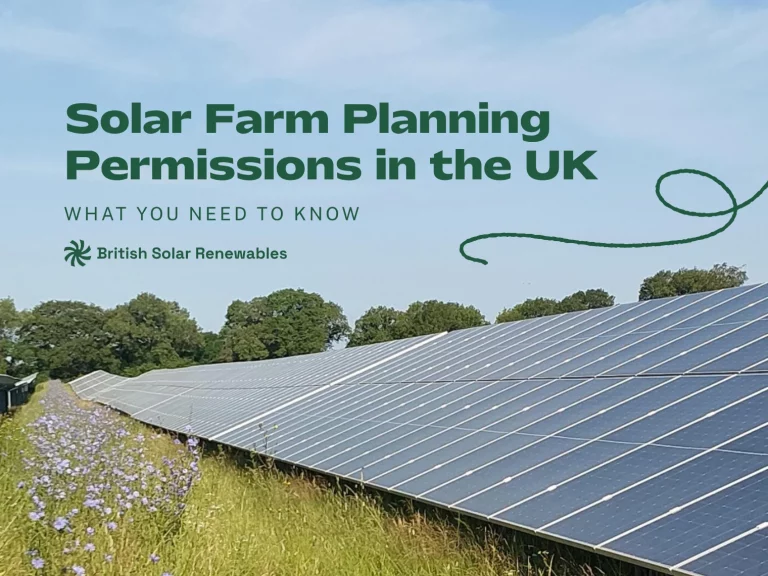
Solar farms can actively support and enhance ecology and biodiversity of the land they occupy. By incorporating features such as wildflower meadows, retained hedgerows, managed ponds, bat boxes and bird boxes, we can create habitats that support local wildlife.
We commit to a minimum 60% biodiversity net gain on every project, a figure calculated across habitat units, hedgerow units, and river units. Some projects go above and beyond. At Knowl Green Solar Park, for example, the project achieved 179.96% habitat biodiversity net gain.
There is also evidence that solar farms can provide suitable habitat for farmland birds. A study by the . The more varied the habitat, the better: sites with a mix of habitats, including hedgerows and areas left uncut for wildflowers supported particularly high bird numbers.
Solar farms also use a relatively small amount of the UK’s land. Solar Energy UK estimates that ground-mounted solar currently accounts for around 1% of UK land use. The Climate Change Committee has estimated that the UK could need 75-90GW of solar by 2050, while analysis reported by Solar Power Portal found that meeting the higher end of that ambition would require around 0.39% of land not already hosting a solar farm.
This means there is an opportunity to generate more clean energy while making thoughtful use of the land alongside it. The land under and around the panels in a solar farm does not go unmanaged. Our Nature Protection Pledge guides ecological and habitat management across its sites, including pollinator planting using species-specific mixes suited to local soil and ecology, alongside habitat creation with the Bumblebee Conservation Trust. For local communities, this means clean energy can be delivered alongside long-term improvements for nature.
Community involvement and sponsorship
Supporting local communities is an important part of how we work. Alongside our planning commitments and community benefit funds, we look for opportunities to support local priorities, get involved in community projects and contribute to initiatives that can make a lasting difference.
Our offices are based in Shepton Mallet, and as a Somerset-based business, we care deeply about the communities connected to our projects. We sponsor local events including the Mid-Somerset Show and Collett Park Day, and our team regularly volunteers with community initiatives. In 2025, our team spent a day volunteering with the Shepton Snowdrops project, helping to plant bulbs across public spaces and roadside verges and contributing to a project that celebrates the town’s heritage and creates a seasonal display for residents and visitors to enjoy.
We also support practical initiatives that respond to local needs. Through our North Dairy project, we funded a publicly accessible defibrillator, which has now been installed in Mappowder Parish. This builds on our work at our Aller Langport site, where we worked alongside the local community, including the village of Oath, to provide a defibrillator for the area. In rural communities, where access to emergency services can take a little longer, having this equipment close at hand can make a real difference for residents and visitors.
For us, these are opportunities to support the places connected to our projects in ways that reflect local priorities. Whether that means sponsoring a much-loved local event, volunteering alongside community groups or helping to provide facilities that benefit residents, we’re proud to play an active part in the communities where we live and work.
What communities can expect during and after construction
Like any construction project, building a solar farm involves temporary activity, including construction traffic, groundworks and some noise. We work to minimise disruption wherever possible, and make sure communities are kept up to date as our work progresses. By listening to local people and working closely with our neighbours, we can make meaningful changes to our plans. For example, at our proposed Brailsford site, feedback from residents led us to pull back solar panels significantly from nearby homes, helping to reduce potential visual impacts and disruption during construction.
We work with local roads and traffic authorities to agree suitable haulage routes and manage construction traffic. We also set out working hours and provide clear points of contact, so residents know what to expect and who to speak to if they have questions or concerns.
Once the site is operational, it runs quietly. The site is made up of panels, managed grassland, and features that support biodiversity, alongside routine maintenance visits. For larger sites, a member of our team is typically on site daily; for smaller sites, visits may be weekly.
We hold public consultation events during the development process and provide opportunities for people to ask questions and share their views. We also make project information available online, so communities near our sites can find updates and contact details through our project consultation pages.
Long-term stewardship: what happens over 40 years
A solar farm is long-term infrastructure. A typical solar project has an expected lifespan of around 40 years, meaning the land will be actively managed throughout that time.
Each site is supported by a Landscape and Ecological Management Plan, which sets out how we will care for the land, its habitats and the wildlife that lives there throughout the project’s lifetime. At the end of the project’s life, planning conditions will generally require the land to be restored, with plans in place for removing equipment and recycling materials.
Many planning permissions also require us to submit a Decommissioning Plan to the Local Planning Authority for approval before work can begin to remove the solar farm. Solar panels are covered by the Waste Electrical and Electronic Equipment (WEEE) Regulations, and we work with approved suppliers to plan for the end of their working life and ensure equipment can be recycled wherever possible.
Our responsibility extends well beyond construction. By managing our sites carefully, supporting local wildlife and planning ahead for the future, we can create lasting benefits for nature and the communities around our projects.
FAQs
Will it affect the view?
We consider the surrounding landscape from the earliest stages of design, looking at how a solar farm can best fit into its setting. Each site is different, so we assess local views, existing vegetation and nearby properties to help inform the layout, panel heights and landscaping. We also develop landscape and habitat plans to help screen our projects and integrate them into the surrounding area, with planting that can soften views of the site as it grows over time.
Can farmland still be used for growing food alongside solar panels?
Solar farms can support farming alongside renewable energy generation. For example, sheep can graze between and around solar panels, allowing agricultural activity to continue. We consider the quality and existing use of the land when developing our proposals, looking at how each site can best balance energy generation, agriculture and opportunities for nature.
Will there be a lot of traffic once the site is built?
Once operational, a solar farm typically generates very little traffic, with visits mainly for routine maintenance. During construction, a Construction Traffic Management Plan (CTMP) sets out how deliveries, access routes and construction traffic will be managed to minimise disruption to local communities.
How can I find out about a solar farm proposed near me?
You can visit our open projects page to find details on our proposals, including dedicated project websites. We consult local communities as our plans develop, giving residents the opportunity to ask questions and share feedback that can help inform the design.
Who do I contact if I have concerns about a site?
Each project website includes contact details for the project team, who can answer questions and provide updates. We welcome feedback throughout the development process and beyond, as local knowledge helps us understand community priorities and consider how our projects can best fit their surroundings.
Find out more
Every community is different. No two projects deliver exactly the same benefits. But our approach remains consistent. We work with local people, invest in the places where we operate and care for the land throughout a project’s lifetime. We believe clean energy should leave a positive legacy, not only by reducing carbon emissions, but by strengthening communities and enhancing nature for the future.
To hear about a BSR solar farm proposed near you, visit our Open Projects page. Each project page provides information about the proposal and contact details for the project team, so you can ask questions or share your views.
You can also visit our local communities page to find out more about how we work with communities.
 About the author: Natasha Worrall, Senior Project Manager
Natasha is a Senior Project Manager at British Solar Renewables, delivering solar and battery energy storage projects and leading BSR’s Community Commitment Pledge.